Every Employee Will Have Agents. Accountability Becomes Infrastructure.
March 30, 2026
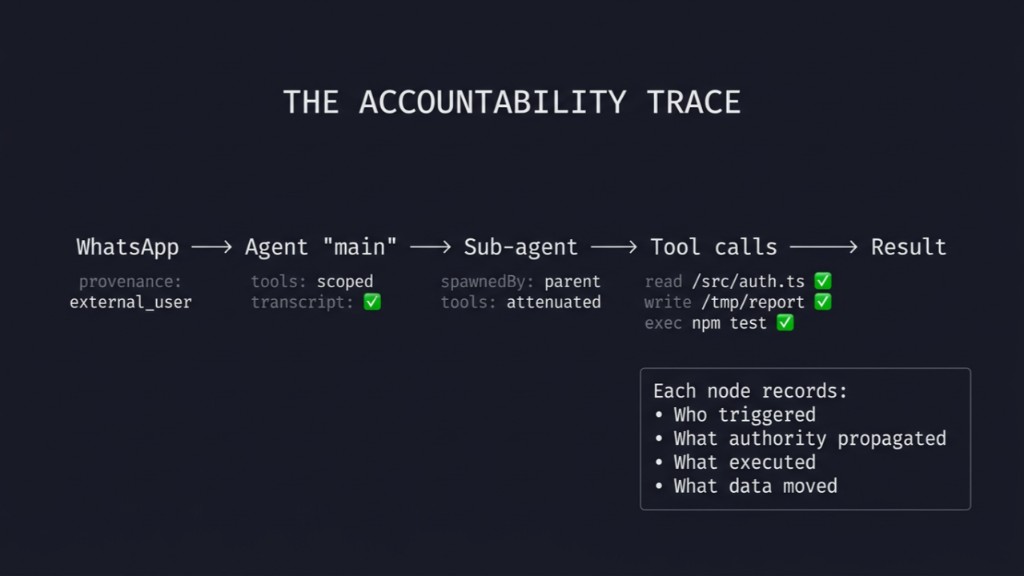
I tried to trace an agent action back to its trigger.
I run OpenClaw locally. 4 named agents, each with its own workspace.
One agent spawned a sub-agent. The sub-agent called three tools, read four files, and produced a summary.
Then I asked myself:
Could I trace that summary back to the original WhatsApp message that started it?
Yes — but it took stitching together 4 separate primitives I didn't know existed.
Accountability in agent systems isn't a name. It's a trace.
Why This Matters Beyond My Setup
One theme keeps coming up in enterprise conversations:
Every employee will soon have agents working for them.
Engineering agents. Data agents. Support agents. Finance agents.
Each acting autonomously and each delegating further.
We're moving:
from: 1 employee → 1 laptop
to:   1 employee → 1 laptop → multiple autonomous agents
An employee asks an agent to pull customer data, generate a report, trigger a workflow. The agent delegates to a sub-agent. The sub-agent calls another tool and the data moves.
At that point — is the employee accountable? The agent? The platform?
Traditional systems didn't have this ambiguity because humans executed actions directly.
Agents change that.
What "1 Employee → Multiple Agents" Actually Looks Like
Here's the directory structure on my machine:
~/.openclaw/
├── workspace/                    ← Agent "main" (default)
│   ├── SOUL.md                   ← Who this agent IS
│   ├── USER.md                   ← Who it serves
│   ├── MEMORY.md                 ← What it remembers
│   ├── AGENTS.md                 ← How it operates
│   └── TOOLS.md                  ← What environment it knows
│
├── workspace-coding/             ← Agent "coding"
│   ├── SOUL.md                   ← Different personality
│   ├── AGENTS.md                 ← Different operating rules
│   └── ...
│
├── workspace-research/           ← Agent "research"
│   └── ...
│
└── agents/
    ├── main/sessions/            ← Separate session store
    ├── coding/sessions/          ← Separate session store
    └── research/sessions/        ← Separate session store
Each agent is a fully scoped "brain":
- Its own workspace (personality, memory, instructions)
- Its own auth profiles (API keys, OAuth tokens)
- Its own session store (conversation history)
tools.agentToAgent.enabled). Filesystem-level enforcement requires tools.fs.workspaceOnly: true or sandboxing.
The workspace IS the isolation boundary.
I could see every agent. Every workspace. Every session file.
But when I tried to trace a single WhatsApp message through an agent and its sub-agent to the final action — I realized I needed to stitch together 4 separate pieces of data that lived in different places.
That's when I found the primitives.
The Accountability Chain Already Exists
Here are the four primitives I found, in the order I needed them to reconstruct the trace:
1. Input Provenance — Who Triggered This?
Every message carries provenance metadata:
{
  "inputProvenance": {
    "kind": "external_user",
    "originSessionId": "session-uuid",
    "sourceSessionKey": "agent:main:whatsapp:direct:+1555...",
    "sourceChannel": "whatsapp",
    "sourceTool": "sessions_send"
  }
}
This lets you trace any action back to the original trigger — whether it came from a human on WhatsApp, another agent via sessions_send, or a cron job.
That's the root of accountability.
2. Spawn Chain — Who Delegated to Whom?
When an agent spawns a sub-agent:
{
  "SubagentRunRecord": {
    "runId": "uuid",
    "childSessionKey": "agent:main:subagent:uuid",
    "controllerSessionKey": "agent:main:whatsapp:direct:...",
    "requesterSessionKey": "agent:main:whatsapp:direct:...",
    "task": "Research authentication patterns",
    "workspaceDir": "~/.openclaw/workspace"
  }
}
The spawnedBy field on session entries (with spawnDepth) creates a parent→child DAG. The controllerSessionKey separates who requested the work from who controls the sub-agent — a nuance for orchestrator patterns.
You can query the full descendant tree via BFS.
Now you can trace: who delegated → who executed.
3. Tool Call Transcripts — What actually happened?
Every tool call and result is persisted in JSONL session transcripts:
{"role": "assistant", "content": "...", "tool_use": {"name": "read", "input": {"path": "/src/auth.ts"}}}
{"role": "tool", "name": "read", "result": "...file contents..."}
This tells you:
- What data was accessed
- What action was executed
- What authority was used
4. Plugin Hooks — Intercept everything
27 lifecycle hooks let you intercept any agent action:
before_tool_call    → validate before execution
after_tool_call     → log after execution
subagent_spawning   → approve or block delegation
subagent_ended      → record completion
llm_input           → inspect model requests
llm_output          → inspect model responses
These hooks allow policy enforcement, governance, logging, and audit.
This is the foundation of agent accountability infrastructure.
What the Accountability Chain Looks Like
Employee (WhatsApp message)
   │
   │  inputProvenance: { kind: "external_user", channel: "whatsapp"}
   │
   ▼
Agent "main"
   │  sessionKey: agent:main:whatsapp:direct:+1555...
   │  tools: read, write, exec, sessions_spawn
   │
   │  spawns sub-agent
   │  spawnedBy: agent:main:whatsapp:direct:+1555...
   │
   ▼
Sub-agent (role: leaf)
   │  sessionKey: agent:main:subagent:uuid
   │  tools: DENIED [gateway, agents_list,
   │          sessions_send, cron, +2 more]
   │
   ▼
Tool calls (logged)
   read /src/auth.ts ✓
   write /tmp/report ✓
   exec "npm test" ✓
   │
   ▼
Result announced back to parent
Every node in this chain has:
- Who triggered it (provenance)
- What it was allowed to do (tool policy)
- What it actually did (transcript)
- Who spawned it (spawnedBy)
What's Still Missing
The primitives exist.
But they're infrastructure, not a product surface.
Here's what enterprises still need:
1. Queryable Execution Graphs
"Show me every action triggered by this employee"
Most systems cannot do this yet.
2. Immutable Audit Trails
Logs exist but not tamper-proof.
Enterprises need:
- Cryptographic logs
- Compliance audit trails
3. Real-Time Monitoring
"Agent accessed CRM 47 times"
This is still missing.
4. Delegation-Aware Revocation
Agent → Sub-agent → Data
Revoke parent… but sub-agent still holds context.
You can't un-read data.
Now Think About the Threat Model
Imagine an agent processes an email with a prompt injection. The agent spawns a sub-agent. The sub-agent reads CRM data and calls an external API.
You detect the breach.
Now answer:
- Which email triggered it?
- Which agent processed it?
- Did it delegate? To whom?
- What tools did the sub-agent call?
- What data did it access?
- Could it have been stopped at the delegation step?
With the primitives I found — provenance, spawn chain, transcripts, hooks — you can reconstruct the full path from the email to the API call.
That's the difference between accountability and hope.
The Shift
The unit of accountability is no longer the user. It's the execution chain.
Traditional security asks: "Who logged in?"
Agent security must ask:
- Who triggered the agent?
- Which agents ran?
- What authority propagated?
- What actions executed?
- What data moved?
Identity proves who. Execution determines what. Accountability traces how.
That's the shift agent systems are forcing.
If your agents started delegating tomorrow…
Could you trace the full execution path from intent to action?
If not — that's the gap.
And that's where agent trust infrastructure begins.