Execution-Centric Authorization: Why Least Privilege Must Be Derived from Execution in Agentic Systems
January 24, 2026
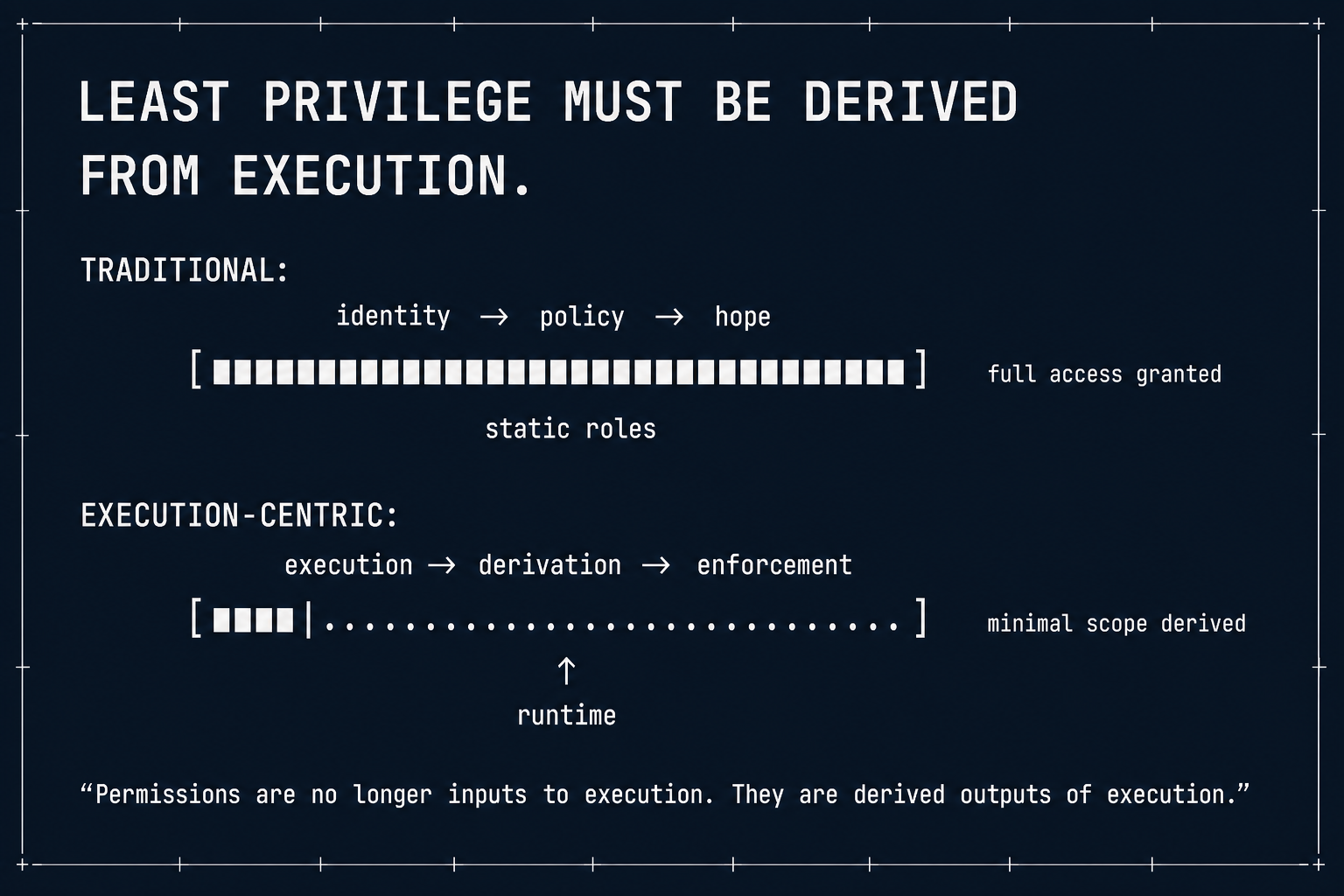
Traditional IAM assumes permissions can be assigned upfront.
That assumption quietly breaks with AI agents.
In the human world, access control works because identities are stable and workflows are predictable. Users are onboarded, roles are defined, permissions are granted, and execution follows.
AI agents invert this model.
They are autonomous, long-running, and adaptive mid-execution. They reason, act, observe results, and replan — often across multiple systems — before the full shape of execution is even visible.
This is why least privilege for AI agents is no longer a provisioning problem. It must be derived from execution and enforced at runtime.
From Identity-Centric to Execution-Centric Authorization
The traditional model looks like this:
Identity → Registration → Role → Permissions → Delegation → ExecutionThis model assumes:
- permissions can be enumerated in advance
- execution paths are known
- delegation is static and safe
The agentic model looks fundamentally different:
Intent → Execution Graph → Minimal Required Permissions → Enforced ActionPermissions are no longer inputs to execution. They are derived outputs of execution.
I think of this shift as Execution-Centric Authorization: access is mechanically derived from what the system is executing right now, not statically assigned based on identity or role.
Why Delegated Permissions Fail for Agents
Most enterprises today secure agents through delegated permissions: OAuth scopes, service accounts, or impersonation tokens granted upfront.
This creates an unavoidable tradeoff:
- Constrain delegation → agents stall, replan endlessly, or fail to deliver value
- Broaden delegation → agents become over-privileged, expanding blast radius
This problem is amplified when agents operate partially or entirely outside enterprise trust boundaries.
Long-running agents do not execute fixed workflows. They discover execution paths dynamically:
- plans branch at runtime
- tool calls depend on intermediate results
- cross-system access emerges late in execution
The question:
"How much access should this agent have?"
is the wrong control question.
The correct one is:
What access does this execution require right now?
A Concrete Example
Imagine an agent tasked with: "Prepare the QBR for Acme Corp."
At runtime, the agent discovers it needs:
- read access to CRM data
- temporary read access to support tickets
- write access to a shared slide deck
- short-lived access to revenue metrics
Granting all of this upfront over-privileges the agent. Restricting it upfront breaks the task.
Only runtime-derived permissions resolve this tension.
Why Execution Graphs Are Hard — and Unavoidable
Least privilege depends on knowing what will be executed.
In agentic systems, that information exists only as an execution graph — and extracting it is hard because execution itself is emergent.
Execution graphs are difficult to capture because:
- planning and execution are interleaved
- tool calls are data-dependent
- cross-system fan-out is dynamic
- LLMs are not reliable narrators of intent
- execution mutates over time
- execution spans trust boundaries
From an IAM perspective, this breaks every assumption behind static permission assignment.
But despite the difficulty, execution graphs are the only sound input from which least privilege can be derived.
Without them:
- permissions must be guessed
- delegation must be over-broad
- blast radius is unknowable
- audit trails are meaningless
What the Agentic Model Requires
Instead of delegating static capability sets, an execution-centric system must:
This moves least privilege from:
identity → policy → hopeto:
execution → derivation → enforcementSix Requirements for Execution-Centric Authorization
Once authorization becomes execution-centric, least privilege stops being a guideline and becomes a set of hard requirements:
Taken together, these requirements imply a deeper shift:
Least privilege for agents is not about assigning permissions. It's about deriving and enforcing permissions from execution.
The Real Takeaway for IAM and Security Teams
AI agents aren't breaking security models. They're exposing where those models were never designed to reason about execution.
Least privilege for agents is:
- not a policy problem
- not an onboarding problem
- not primarily an identity problem
If your system cannot observe and constrain execution as it unfolds, you don't have least privilege — you're just capping worst-case damage.
Curious how others are operationalizing AI agents today, especially for long-running agents and third-party tools operating across trust boundaries?