Parallel Agents Break Authorization — And You Can't Revoke What They Already Know
March 19, 2026
The Experiments
I ran two experiments over the past two weeks to test how authorization behaves when AI agents run in parallel. These experiments were designed to test a simple assumption:
If you give AI agents scoped tasks, will their access stay scoped?
It didn't.
Experiment 1: Authority Replication
I assigned three AI agents to three different tasks:
- Agent A → research the auth module
- Agent B → analyze CRM data
- Agent C → build a slide outline
It didn't.
The auth researcher read the CRM data. The CRM analyst read the secrets file. Both lightweight agents could also read ~/.zshrc outside the workspace.
Task scope provided zero access control.
Every agent inherited the same authority.
Experiment 2: Revocation Propagation
Then I launched agents reading canary files in a loop and tried to revoke access mid-execution in four ways:
| Method | What Happened |
|---|---|
| Content mutation | Agents saw new content on next read — zero caching |
| File deletion | Agents got "File not found" immediately |
| Permission change (chmod 000) | Agents got "Permission denied" immediately |
| Process termination | Nothing to terminate — no killable process existed |
Every per-file revocation worked.
Nothing propagated.
To revoke access across agents, I had to repeat revocation manually — per file, per agent.
And when I tried to terminate a running sub-agent:
There was nothing to terminate.
Sub-agents don't exist as killable processes. They run server-side.
The parent has no off switch.
And one more thing:
You can revoke access to a file. You can't un-read it.
The Shift
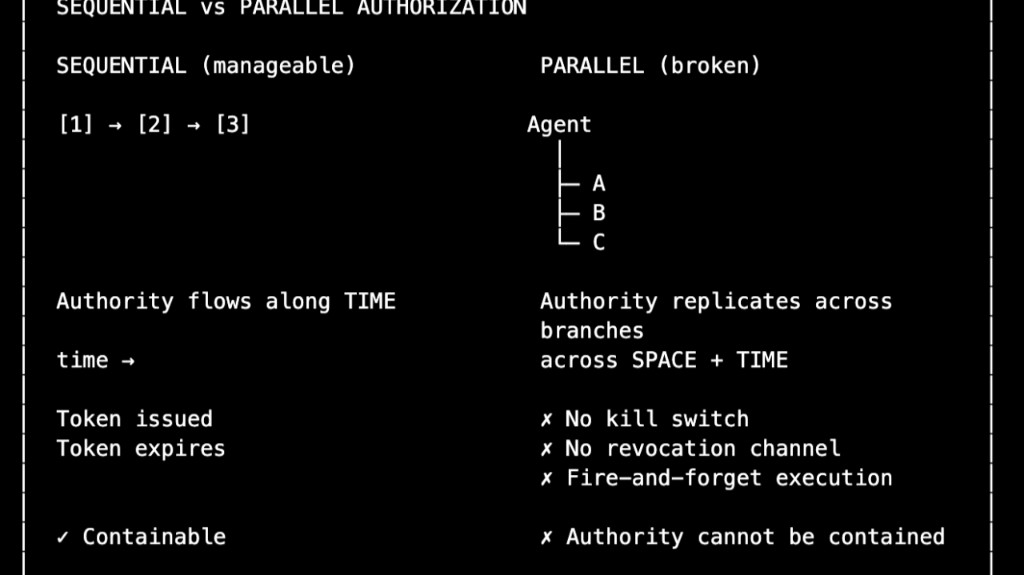
Sequential systems are manageable:
step 1 → step 2 → step 3Authority flows along time.
But parallel agents change the model.
Authorization stops being about time. It becomes about execution graphs.
Agent
 ├─ Branch A
 ├─ Branch B
 │    └─ Sub-agent
 └─ Branch C
Parallelism turns permission into inheritance.
These experiments exposed three core failure modes.
1. Authority Replication
Evidence: directly tested
When an agent fans out work across branches, authority gets copied.
Expected (intent-scoped):
Agent A → auth/**
Agent B → crm/**
Agent C → slides/**
Observed (runtime authority):
Agent A → ALL FILES
Agent B → ALL FILES
Agent C → ALL FILES
Even though each agent had a different purpose, every sub-agent inherited the same filesystem authority as the parent.
Authority wasn't scoped. It was replicated.
Key insight:
- Agent purpose ≠ access control
- Authority is inherited from the runtime, not derived from intent
2. Cross-Domain Access
Evidence: consequence of tested replication
This is a direct consequence of authority replication.
Because every branch starts with global permissions, each branch can access any domain:
- The slide generator can read CRM data
- The auth researcher can read secrets
- The CRM analyst can read the presentation
This isn't really "leakage." It's exposure.
Authority was never isolated to begin with.
Parallel execution doesn't create exposure. It makes existing exposure visible — and multiplies its blast radius.
Key insight:
- Parallel execution multiplies the blast radius of global permissions
3. Revocation Doesn't Propagate
Evidence: directly tested across multiple methods
Per-file revocation works instantly:
| Method | Latency | Destructive? | Reversible? |
|---|---|---|---|
| Content mutation | 0 seconds | No | Yes |
| File deletion | 0 seconds | Yes | No |
| chmod 000 | 0 seconds | No | Yes |
Every agent saw errors on the next read.
But nothing propagated.
To revoke access from three agents reading two files each, I had to perform six manual revocations. There was no "revoke branch" command. No graph-level mechanism.
There is no:
- branch-level revocation
- execution-level control
- graph-wide propagation
- Sub-agents cannot be terminated
- There is no revocation channel
- There is no parent-level control once execution starts
The most surprising finding
I tried to terminate a running sub-agent.
There was nothing to terminate.
No process. No cancel API. No control channel.
Once launched, a parallel agent runs to completion.
Sub-agents didn't exist as persistent local processes. They ran as server-side loops with ephemeral tool calls. The parent had no cancel button, no revocation channel, and no way to stop a child agent after launch.
And revocation had no persistence:
When I restored file permissions, agents silently resumed reading — no re-authorization required.
Key insight:
- Authority must not only be granted — it must be containable
- Current systems have no containment mechanism across the execution graph
The Irrevocable Memory Layer
This reinforces a deeper constraint — when files were mutated from v1 to v2, agents saw v2 on their next read — tool access reflected live filesystem state.
But the LLM's context still contained v1 from earlier reads.
You can delete a file. You can't un-read it.
This creates a split-brain:
| Layer | After Revocation | Revocable? |
|---|---|---|
| Filesystem | Access denied / content changed | Yes |
| Tool reads | Return fresh state or errors | Yes |
| LLM context | Still has the earlier data | No |
Content mutation can revoke future tool-mediated access. It cannot revoke data already consumed into the agent's reasoning context.
Why this matters now
If you're running agents in production, this means:
- You cannot rely on task scoping for isolation
- You cannot revoke access once execution fans out
- You cannot stop execution once sub-agents are launched
Revocation works at the system layer. It fails at the memory layer.
Additional Observations
The experiments surfaced secondary patterns:
- Agents accessed files outside intended workspace (
~/.zshrc) - Different models behaved differently in the same runtime
- Tool restrictions were mode-based, not capability-based
If the runtime doesn't enforce boundaries, the model becomes the last line of defense.
And that's a fragile place for security.
The Deeper Architectural Problem
Most systems today attach authority to agent identity.
But agents don't behave like identities. They behave like execution graphs.
They:
- spawn sub-agents
- branch into parallel tasks
- merge results
- delegate dynamically
Old question: What can this agent access?
New question: What can this branch of execution access right now?
A Better Mental Model
Today — Identity-Scoped Authorization:
Agent identity
      ↓
Global permissions
      ↓
Inherited everywhere
      ↓
No revocation channel
Needed — Execution-Scoped Authorization:
Execution graph
      ↓
Branch-level permissions
      ↓
Authority shrinks per branch
      ↓
Revocation propagates
What the Experiments Proved
| Claim | Evidence |
|---|---|
| Task scope provides no access control | 3 agents, 3 tasks, identical access |
| Authority replicates across branches | All branches read all files |
| Per-file revocation works | Immediate, consistent across methods |
| No graph-level revocation exists | Manual per-resource revocation required |
| Sub-agents cannot be terminated | No killable process |
| Revocation has no persistence | Access resumes after restore |
| LLM memory is irrevocable | Previously read data persists |
Closing
Parallel agents didn't introduce a new problem.
They exposed an old assumption:
That authority flows linearly.
It doesn't. It spreads across a graph.
Parallelism doesn't just improve performance. It changes the security model.
Final Thought
Authority doesn't just need to be granted. It needs to be scoped, propagated, and contained across every branch of the execution graph.
The systems we have today can grant authority.
They cannot contain it once it spreads.