Running 8 Parallel Agents with Explicit Specs and Execution Model
March 7, 2026
I've been running 8 AI agents in parallel off a single design doc.
Not by throwing better prompts at them but by being very explicit about the specification and execution model.
Here's how I'm structuring it.
Once the design doc is approved, I break it down into workstreams (WS-<ID>).
Each workstream maps to a clear service boundary and a corresponding Git worktree.
That mapping is what lets me dial up parallelism safely. More service boundaries → more worktrees → more agents running without stepping on each other.
From there, everything runs on a batch execution model.
I group tasks into batches and waves based on dependencies:
- what can run in parallel
- what has to be sequential
- where parallel work needs to converge
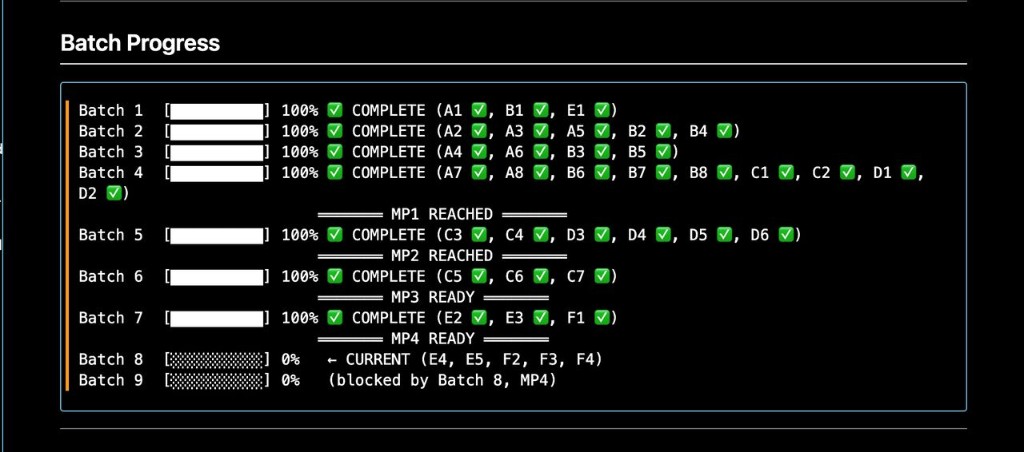
- Batch 1: A1, B1, E1 (all parallel)
- Batch 2: blocked on Batch 1
- Merge Point MP1: A8 + B3 → unlocks C1
- which batches are done vs active
- what's blocked vs runnable
- where merge points are gating progress
- what the critical path looks like
- Batches 1–7 complete
- Batch 8 actively running
- Batch 9 blocked on Batch 8 + Merge Point MP4
At the task level, every task has a spec, tracking metadata, and verification before anything downstream unblocks.
Tasks run across multiple Cursor + Claude sessions — parallel where they can be, sequential where dependencies force it.
When a task finishes, I capture learnings back into CLAUDE.md.
And just as importantly, it surfaces where my specs are wrong, where assumptions break, and what needs tightening. That feedback loop is what lets me fix issues early instead of discovering them after everything fans out.
With this execution model in place, I'm starting to map the same structure onto agent teams and sub-agents, and I'll also share a follow-up on how this shift completely changed how I think about authorization for AI agents.