Spec Drift: When Parallel Agents Are Individually Correct but Collectively Wrong
May 1, 2026
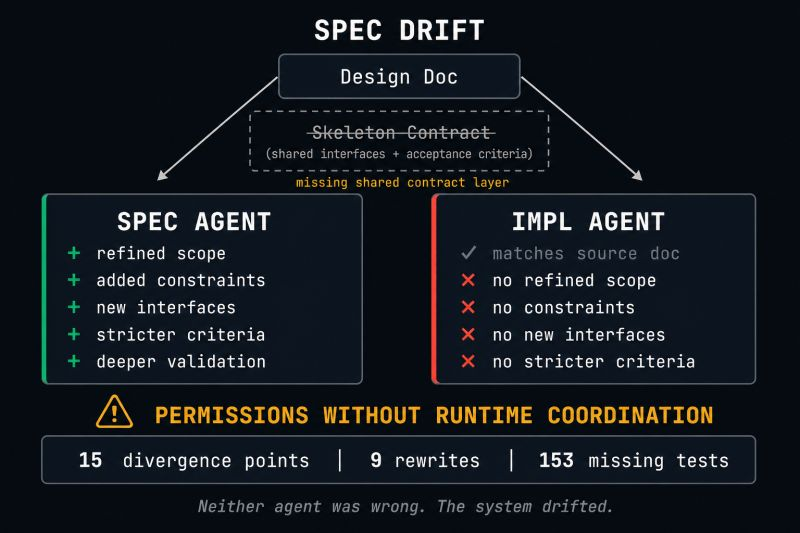
I ran two AI agents in parallel on the same codebase. One wrote specifications while the other wrote code.
They started from the same design document and the same feature set. Both launched from the same command — the implementation started executing before the specification was fully written.
Both finished and both passed their own checks.
When I audited the outputs afterward, I found 15 divergence points, 9 components that needed rework, and 153 tests missing entirely.
The implementation agent had built exactly what the design document described.
At the same time, the spec agent had independently evolved the requirements beyond the original document — refining scope, adding constraints, tightening criteria, and deepening validation.
Neither agent was wrong. The system drifted.
This is "Spec Drift" — parallel autonomous agents diverging because they each reason about a shared source independently, without observing each other's intermediate decisions.
The fix was surprisingly simple: extract a skeleton contract — interfaces, API shapes, acceptance criteria — before launching both agents. Drift dropped from ~40% to under 5%.
The technical fix was simple. The implication wasn't.
This is the exact failure mode coming for every enterprise deploying multi-agent systems.
Not one rogue agent, but thousands of autonomous systems — each individually correct — coordinating incorrectly.
"Can this agent access this resource?" That question matters.
Permissions are necessary. But they're not sufficient.
Multi-agent systems need a second question: "Are these agents still aligned with each other?"
That's a runtime coordination governance problem — and the metric that matters is coordination integrity.