Uber's AI Agent Identity Architecture — And Why Governable Execution Is the Next Frontier
May 26, 2026
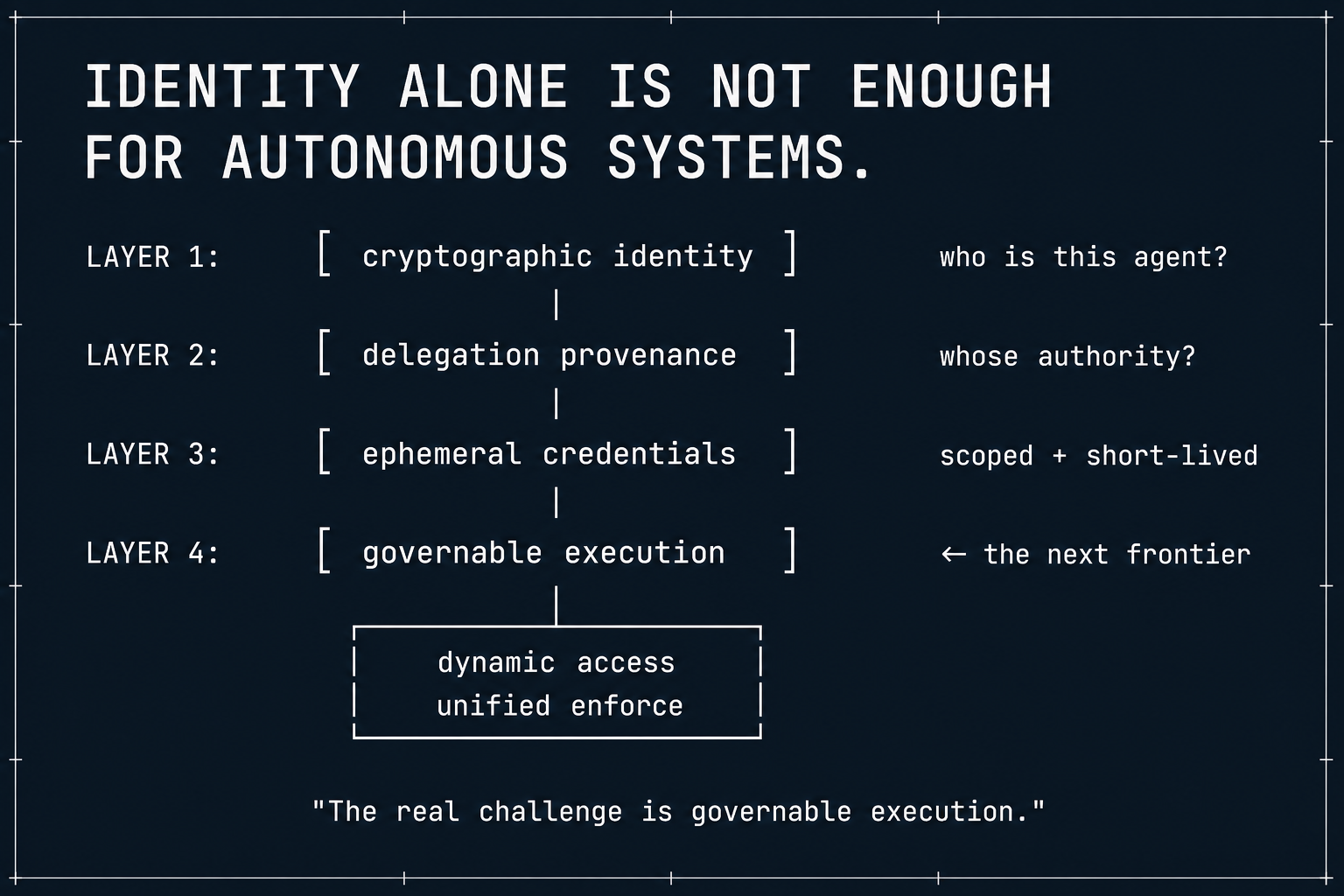
A week ago, Uber published one of the most important public architectures I've seen so far for AI agent identity.
Really appreciate the Uber Engineering and Security teams for sharing this publicly — and congratulations to everyone involved in getting such a thoughtful system into production: Matt Mathew, Prasad Borole, Meng Huang, Gaurav Goel, Sergey Burykin, and Bayard Walsh.
What resonates most is the principle set behind the architecture:
- AI agents need real cryptographic identity
- delegation needs provenance
- credentials should be ephemeral and scoped
- authorization must evolve toward context- and workflow-aware controls
It also strongly aligns with how we think about agent security at DeepTrail: cryptographic agent identity, runtime policy enforcement, secure delegation with attenuation, execution-level auditability, and short-lived credentials instead of standing access.
The industry is converging on the same realization:
Agent security cannot be bolted on with shared API keys and generic service accounts.
What I especially respect in Uber's post is the engineering honesty. The hard part is not drawing the architecture. The hard part is making it work across real platforms, real gateways, real legacy paths, and real scale.
That operational reality matters because Uber's architecture is built on top of SPIFFE/SPIRE — a workload identity foundation that took years to mature internally.
For many enterprises, this is where deployments become difficult:
- legacy systems never fully onboard
- SaaS APIs sit outside workload identity
- third-party delegation breaks trust boundaries
- revocation remains inconsistent across execution chains
What becomes interesting next
The layer Uber hints at in their roadmap:
- Dynamic Access Control
- Unified Enforcement Plane
The problem shifts from identity issuance to governable execution:
- what the agent is trying to do
- on whose behalf
- under what constraints
- with what downstream blast radius
- execution-scoped authorization
- intent-aware delegation
- bounded-damage enforcement
- secure multi-cloud and SaaS credential mediation without exposing raw credentials to agents
Thanks again to the Uber team for publishing this. The more architectures companies share publicly, the faster the industry converges on security models that actually work.